






TL;DR: We introduce Dyad, an architecture that combines pretrained LLMs’ language reasoning with native typed decision-making over dynamic action spaces to build more capable general-purpose agents.
LLM agents typically use the same text-generation interface to reason about goals and specify actions. This assigns probabilities to vocabulary tokens rather than directly to the operations an environment provides. Some LLM extensions support direct actions, but restrict them to fixed, predefined choices. Dyad introduces an environment-conditioned action encoder that builds the decision interface from action descriptions, allowing the available choices to change with the environment.
Unable to play the video here. Open the overview MP4.
1. Modular Adaptation with a Frozen LLM
Modular adaptation asks how much an agent can improve by learning a new decision interface on top of an existing LLM. We train only Dyad’s action encoder through reinforcement learning, without updating any LLM parameters. The resulting agent improves over the original LLM in all four unseen environments (Table 1). The largest gain is on household tasks, with improvements also extending to web shopping, tool use, and software engineering.
| Environment | Original LLM | Frozen Dyad | Gain (%) |
|---|---|---|---|
| ALFWorld | 45.66 | 48.82 | +3.16 |
| WebShop | 33.43 | 35.00 | +1.57 |
| τ²-bench | 62.17 | 64.23 | +2.06 |
| SWE-bench Verified | 44.56 | 45.50 | +0.94 |
2. Stronger Agents with Preserved General Capabilities
Joint optimization allows the LLM and action encoder to learn together from interaction rewards. We train in a single environment, then test in four unseen environments without further training. Dyad outperforms both the original LLM and conventional RL across all four (Figure 1). On tool use, it also avoids the regression observed with conventional RL.

Agentic post-training can also change the LLM’s broader capabilities. We therefore evaluate knowledge, mathematical reasoning, and coding alongside agent performance (Figure 2). Dyad improves all three capabilities over the original LLM across both training environments. Where conventional RL causes capability losses, Dyad recovers them; where it already yields improvements, Dyad increases them.


Approach
A shopping agent must reason about a customer’s requirements and compare products, while repeatedly choosing actions to search, inspect items, and complete a purchase. The two computations are analogous to System 2 reasoning and System 1 decision-making. Dedicated models such as Jev focus on predicting typed decisions directly. Dyad integrates this ability with a pretrained LLM’s language reasoning within a single policy (Figure 3).

Dyad represents the interaction state and action semantics separately (Figure 4). The pretrained LLM encodes the evolving history, while the action encoder embeds candidate descriptions in their environment context, independently and in parallel. Action representations can be reused while their descriptions and environment context remain unchanged; newly encountered actions are encoded as needed.
Architecture overview
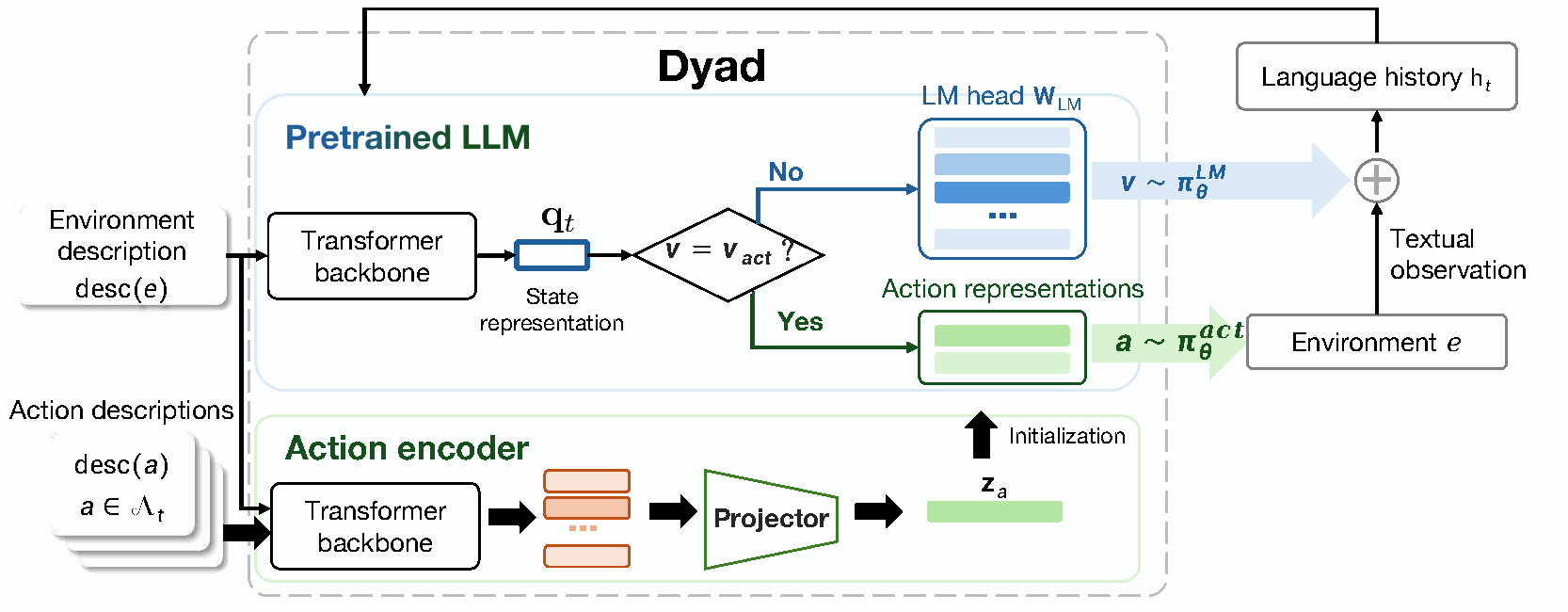
The language head generates tokens as usual. Emitting an interaction token switches to action selection: the current LLM state is scored against the candidate representations to produce a distribution over available actions. The selected operation executes in the environment, and the resulting observation is added to the interaction history.
Before reinforcement learning, we align the action and state representations using supervised action-selection examples. This stage trains only the action projector, keeping both transformer backbones fixed. The policy then learns from environment interaction through task-outcome rewards.
| Method | Overall | Hard |
|---|---|---|
| Jev 1.13 | 85.01 | 70.88 |
| Original LLM | 79.10 | 59.88 |
| Dyad | 86.18 | 72.08 |
JevBench evaluates standalone decisions through classification, yes/no judgments, and ratings. Here, we compare the jointly trained agent with a dedicated System 1 model, complementing the multi-step evaluations above. Dyad achieves absolute gains of 7.08% overall and 12.20% on hard cases over the original LLM. It also slightly exceeds Jev on both metrics (Table 2).
BibTeX
@article{zhan2026dyad,
  title={Dyad: Extending Large Language Models with Native Typed Decision-Making},
  author={Zhan, Yundaichuan and Wang, Weishi and Liu, Wenbiao and
          Dahlmeier, Daniel and Qin, Chengwei and Li, Juncheng and
          Johansson, Fredrik D. and Yue, Zhongqi},
  journal={arXiv preprint arXiv:2609.36116},
  year={2026},
  url={https://arxiv.org/abs/2609.36116}
}